
We’ve well and truely finished the Pan-American now. It’s been two month since we sold our van and left Chile. Now we’re on our way to Europe to spend summer there. I thought I’d write a brief summary of the trip with tips for anyone else who might be contemplating undertaking a similar adventure.
We didn’t really plan anything
We decided to do this trip only two months prior to actually leaving. The idea came to us in March and we left in May. Our planning consisted of, well, very little. I checked that Covid and Visa policies of all the countries in South and Central America, just to make sure we wouldn’t need to organise visas of get some sort of vaccination evidence translation. I did some research on the formalities of purchasing a van in the US (i.e. is it possible and how much does it cost). We arranged for our first week to stay with some friends in Los Angeles. The rest of those two months was spent tidying up affairs at home – i.e. renting out the house, selling the car, organising storage, exiting our jobs and enjoying the last days of the Australian summer. While I kinda wanted to make more concrete plans we really had no clue how this was going to work out and it’s somewhat futile to try and guess this sort of thing. The only regret I do have was not getting a head start in learning Spanish. Some intensive online learning with a human Spanish teacher in Australia would have made a big difference. We ended up learning enough to fumble our way through Latin America but the trip would have had a whole different dimension if we’d been able to speak with the locals better.
Digital Tools of the trade
One thing we did prepare properly was to get my iPhone ready for the trip. The humble smartphone has made the task of Overlanding an almost trivial exercise, and is probably the main reason why we were able to get away without doing any planning. Here’s the essential list of Apps that we downloaded for the trip and which we used daily.

The iOverlander App was an absolute godsend. It’s simple, easy to use and all it really does is landmark spots on a map of the world that might be helpful to Overlanders. Wild camping spots that people have discovered, auto repair shops, laundry mats, hostels, campsites etc. All the content is user generated, there’s no advertising. And it’s free. As an App developer myself I do wish that more Apps were like this. If you use it then I’d certainly encourage you to donate to the developers as I know how hard it is to keep this sort of service well curated and running.
Next up are the numerous Facebook Groups that deal with the Pan American. The Pan American Travellers Association is easily the best. The search button that Facebook provides to search historic group posts is a fantastic resource of questions and answers on every conceivable topic. If you’re stuck wondering how to get a pet monkey through Panamanian customs, then there’s every chance there’s some tips buried somewhere in the group. Most of the countries also have their own traveller specific groups, such as Argentina Travel Tips. These groups don’t specifically relate to overlanding but can help get a feel for where all the normal tourists are and what they’re all doing.
For navigation we used Google Maps and occassionally Maps.me. Waze is also very popular in South America. Whenever we had a WiFi connection I’d download offline Google Maps for the region we’ll be spending the next week, as quite often we were out of cell tower range. If you don’t know how to download offline maps then I’d recommend giving it a try. It’s a life saver for whenever the internet is down or your cellphone plan has expired. You can even use turn-by-turn navigation offline, although traffic information obviously won’t be loaded up in this case.
Speaking of staying connected, we bought a different SIM card in each country that we visited. Most of the other overlanders we met were doing the same. SIM cards are really cheap in Central and South America and they’re easy to find. For example, right now I’m on using a Brazilian SIM which costs A$15 for 2 weeks for 7GB. The only real downside of this is that our Australian numbers don’t work. This can be an issue when trying to login to any service that requires a security code to be SMSed to your phone. In the end I tried to make sure that I’d disabled this on all my bank account by switching to some other authentication method. It hasn’t really been a problem so far but that’s mainly because we cut ties enough to keep a low responsibility footprint back in Australia. If we’d needed to stay in touch more I might have kept my Aussie SIM in a second burner phone.
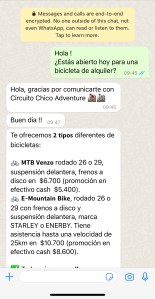
WhatsApp is used everywhere in Latin America (but not in the US) both for personal communication but also as a tool to connect to business. The business option is incredibly handy when making bookings or asking questions from hostels, tours, scuba diving classes etc. Let’s say you’ve found a hostel that you’d like to book for the night and want to check if they have space. Find them on Google Maps and somewhere on that maps profile there’ll be a link to their WhatsApp account. This link will directly start a chat session between you and them. If your Spanish isn’t quite up to a navigating a nuanced conversation about booking a room then you can use Google Translate to conduct the conversation with the hostel. This saves trying to call them and make yourself understood, or sending emails that never get answered. Almost every business in Latin America has this facility setup and it makes communication so much easier. Here’s an example chat of me making an enquiry to book some bikes for an afternoon in Argentina.
The cost? $58,000 AUD
That’s over a total of 9 months, which I don’t think is too bad. As expected the expenses related to the van cost the most. In total the van ended up costing us about $20,000 in gas, insurance, repairs and the fact that we sold it for a loss in Chile. Considering the crazy distances that we drove it, and the fact that it served as a place to sleep, cook and way to visit places impossible to see otherwise, that doesn’t seem terribly expensive.
The next biggest expense was what I termed Holiday expenses. This was stuff like the 5 day sailing trip from Panama, hotels, paragliding in Colombia and other activities, visiting national parks & museums etc. This came to an about $19,000.
Finally, the balance of the expenses was things like Food, Eating Out, Spanish lessons etc.
So that’s how we drove the Pan-Am from Alberta to Chile. We got everything back home squared off and running on autopilot, downloaded a few Apps, jumped on a plane and figured it out from there. We had a very rough timeline, and an even rougher budget but I don’t think that a detailed plan survives long on a road trip of this length. In the end it was an absolutely amazing journey and I think part of the reason for that was the serendipity that comes with taking each day at a time. I mean, how can things not go to plan when there was no plan to start with 😉
 Adrian Falvey
Hi Adrian!
Love that breakdown of your trip, super useful! My partner and I are two Aussie’s looking to do the pan am this year and have about the same amount of time as you (9 months). Great to hear you managed to travel that distance in that time, we’re pretty get up and go sort of travellers so we’d love to see as much as possible. How did you go about buying a car in the states and then selling in Chile? What time of year did you start your trip? Thanks so much! Rosie
LikeLike
Hi Rose. 9 months is definitely enough, although we didn’t go all the way up to the top of Alaska. We started the trip in June in Colorado to catch the northern summer. The problem with that is it’s unbearably hot in Mexico, particularly Baja, so we went north for a few months to let it cool down. The planning around buying the van is definitely the only serious consideration you need to make for the trip. It’s best to get a US registered vehicle and get the US title for it. You also need to be transfer the title when you come to sell it, and not every US state lets you do this from overseas. In fact very few do. I believe that Montana does, which is why lots of Pan-American travellers registered their van there. This site https://www.visitor.us is a really useful resource. To be honest, if I was doing it again I’d start in Santiago, by a US van from a desperate traveller there who has finished their trip. Then drive it north to the US and sell it there. Buy low, sell high. That said, it’s way more comfortable starting in the US for language and obvious cultural reasons. The Pan-Am is amazing – you’re going to love it!
LikeLike